sábado, febrero 26, 2011

Maltrato en el Comercio Exterior


Colombia and the United States
Feb 17th 2011 | BOGOTÀ

Trade disunion 
Santos´s China card  
From The Economist print edition


SOMETIMES the way the United States behaves in Latin America seems calculated to oblige its friends to seek other allies. Take Colombia, the most pro-American country in the region over the past decade. Not only has the United States Congress failed to ratify a free-trade agreement signed in 2006, but this month it failed to renew trade preferences dating from the 1990s under which more than half of Colombia´s exports enter tariff-free.

The failure to renew the Andean Trade Promotion and Drug Eradication Act (ATPDEA) was caused by a domestic political squabble, and may soon be rectified. But Colombia is getting fed up with American disdain. Its new president, Juan Manuel Santos, says that if the trade agreement is not ratified this year, "we will not keep insisting." The United States is Colombia´s biggest trade partner. Mr Santos hopes the agreement will boost investment. But the ATPDEA, a tool in the American drug war, already helps Colombian exporters, so their American counterparts have more to gain from ratifying the trade agreement.

Barack Obama´s administration has been lukewarm, because many Democrats think free trade kills jobs and some worry about human-rights violations in Colombia. Mr Obama has said that he would not push for ratification until he was "certain they are not killing union leaders" in Colombia. Nevertheless, this month he told Ron Kirk, his trade representative, to find out whether there are fewer killings and more are being punished.

Mr Kirk will be disappointed. Last year 49 union members were killed, say the unions, or 34 (a fifth higher than the previous year) according to the government. A special unit of the prosecutor´s office is investigating 1,300 killings of trade unionists, stretching back to 1986, but has achieved convictions in only 14% of these cases.

Yet these numbers represent a lower death toll and higher clean-up rate than those for Colombians who are not union members. It is unclear how many of the deaths are related to union activities. And anyway, many Colombians argue that by boosting economic growth the agreement would help strengthen human rights.

Mr Santos´s government is showing "genuine concern" over the killing of trade unionists, according to José Miguel Vivanco of Human Rights Watch, a New-York-based group, which opposes the trade agreement. It is also showing rather more determination than its predecessor against the criminal gangs which are often behind the killings.

With Republicans running Congress, the agreement may have more chance of ratification. The Senate Finance Committee has asked Mr Kirk to present a plan to settle the disagreements by March 9th. If it is finally ratified, Colombia may have China to thank. Evidence to the Senate foreignrelations committee forecasts that China, already Colombia´s number two trade partner, will become the biggest in the next decade without an agreement. That may concentrate minds in Washington


COPYRIGHT © 2011 DePapaya.com
Reproduction in whole or in part, without written permission is prohibited.
All rights reserved.

martes, febrero 08, 2011

Cuando un Mapa nó es un Mapa ?


GIS News, Articles, Maps, Data, Tools

Sunday, February 6th 2011
When is a Map Not a Map?
By Adena Schutzberg

Summary: The term "map" has a very broad definition, especially for those who study geography. But, what one thing can you remove from a map to make it something other than a map? Executive Editor Adena Schutzberg found out one morning when her vision of a map was in complete opposition to one found on a friend's GPS-enabled running watch.

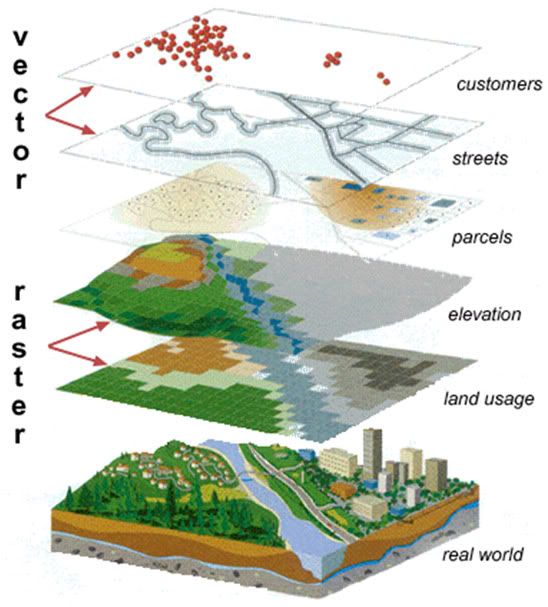
Topology of a GIS "Map".

Recently, while out running with a group, Victor described how he'd spent some time the previous day watching a YouTube video about his GPS watch.

He's had a Garmin Forerunner 405 for a few years now, and had finally gotten around to exploring the functionality that's supposed to help guide you back to your starting point. My older model of the Garmin also has this functionality and I, too, had never bothered to learn about it.

Our conversation went something like this:

Victor: It has a map.
Me: A map? Of just the U.S.?
Peter: No, an etch-a-sketch map.
Me: With streets on it?
Victor: Yes.
Me: How detailed?
Victor: Well, when you zoom in you just see lines.
Me: Are there street names?
Victor: No.
Me: Then it's not a map.
Victor: Yes, there's a map!

We ran another half-mile or so until I parsed the very accurate description of the maps created on the Forerunner. And, the key word was "etch-a-sketch." When another runner, Peter, referred to "etch-a-sketch," I didn't really think of the old red-bordered drawing tool with two knobs, but rather the most line-like, worst maps I could picture. I conjured up a map made of TIGER data, which of course has some smarts and covers the U.S. I was thinking of the basemap onto which a route would be drawn. Victor and Peter were thinking of the map that mattered to them, the map of the route, but without a basemap. That would indeed look like an "etch-a-sketch" map, a bunch of lines with no basemap, and thus, no context.

What I could not imagine, in 2011, of course, was that any electronic device would not have a basemap. The Garmin Forerunners, at least the ones we were using, do not have a basemap. The map is indeed, just an "etch-a-sketch" line with no basemap, no coordinate references and amazingly, no real-time, "you are here" symbol. When Victor noted it had streets on it, I finally understood that he meant it draws the streets that you run down.

Victor noted that the device provided an arrow that pointed to your starting point and provided a "crow flies" distance to it. He suggested you could use that information, along with the "etch-a-sketch" map, to navigate back to the start of the run. I really didn't like that idea at all. I far prefer to use landmarks to navigate my way back.

Now, while it's interesting that in 2011 the Garmin sports devices we carry do not include any sort of maps, it's far more interesting to me that my understanding of a map required a basemap and Victor's did not. I studied cartography and have a master's degree in geography. Victor studied astronomy and is always making fun of his lack of a sense of direction. Victor uses his iPhone's navigation quite a bit. "I'm using the blue dot to get to ..." he's been known to write on Facebook. I have yet to use Google Maps on my Android device.

When I began studying geography I really liked the broad definition of a map: "A map is a representation of a structure and a structure is a set of elements and the relationships between them." When I learned that in my "Human Habitat" course in college the professor drew a benzene ring (the 6 carbon atoms linked together in a circle) and asked me (knowing I was majoring in chemistry) if that was a map. I said it was. We were in agreement.

Spin forward nearly 30 years, and I have 20 years of experience using GIS. Now my understanding of a map is very different. Perhaps 98% of the maps I've seen or created in my career in geospatial technology were some version of "dots on a map," that is, data of interest (points, lines or polygons) overlaid on a basemap. Sure, some of those data came from analyses, but the end results were plunked down on a basemap. That's still, I'd argue, the killer geographic visualization product. If it were not, why would Google, Bing, Yahoo, MapQuest, OSM, Esri and others offer up such lovely basemaps onto which to plunk down our data?

Today, the dominant graphic most people have in their head when asked to picture a map is, I suspect, of data on top of one of these basemaps. I'm not sure if that's for the best or not, but I do appreciate that at least some people, Victor for one, have no qualms about a map not being placed on a basemap. That said, I fully expect Garmin to add basemaps of some kind to the Forerunner devices in the near future.


COPYRIGHT © 2011 DePapaya.com
Reproduction in whole or in part, without written permission is prohibited.
All rights reserved.

miércoles, febrero 02, 2011

Se agotan las direcciones de Internet

JANUARY 31, 2011, 8:18 P.M. ET.
Se agotan las direcciones de Internet y el mundo se prepara para un gran cambio.
Por: Ben Worthen y Cari Tuna


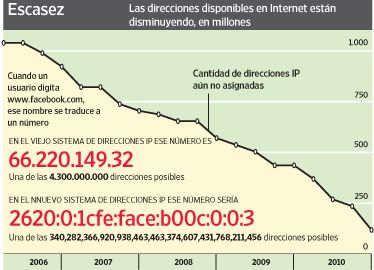
Internet está a punto de quedarse sin direcciones nuevas, un hito que está alentando a gigantes como Facebook Inc. y Google Inc. a desarrollar nuevas versiones de sus sitios web e incitando a proveedores de servicio y otras compañías a mejorar sus redes.

Esta semana, se espera que la organización que supervisa Internet, ICANN, reparta el último lote de direcciones de protocolo de Internet (IP, por sus siglas en inglés) existentes. Estas direcciones dirigen el trá fico en la red a la ubicació n correcta de forma parecida a la que una carta encuentra su camino a travé s del sistema postal.

Si bien existe un nuevo sistema de direcciones IP listo para ser lanzado, no es compatible con el actual. En junio, por lo tanto, Google, Facebook, Yahoo Inc. y otros cambiarán a las nuevas direcciones por un día en la primera prueba a gran escala de la nueva red, llamada IP versión seis o IPv6.

Aunque el cambio permanente a un nuevo sistema de direcciones de la web todavía está muy lejos, ya es inevitable, aseguró Lorenzo Colitti, un ingeniero de Google que está ayudando a supervisar la transición de la empresa a IPv6. El cambio "es fundamental para preservar Internet tal y como la conocemos" y es la única manera que Google tendrá de poder ser accesible a futuros usuarios de la red.

El actual sistema, IPv4, fue desarrollado hace más de 30 años y permite unos 4.300 millones de posibles direcciones. En los años 70, esa cantidad era más que suficiente ya que Internet sólo conectaba a una pequeña cantidad de investigadores de agencias gubernamentales y universidades. En la actualidad, no obstante, todo tipo de aparatos se conecta a Internet, así como un creciente porcentaje de la población mundial.

Si la conversión a IPv6 va bien, la transición, que probablemente sucederá gradualmente a lo largo de varios años, no tendrá un gran impacto en los consumidores. Los expertos en redes dicen que algunos viejos sistemas operativos y routers no funcionarán con las nuevas direcciones, pero sí los comprados en los últimos años.

Las empresas, sin embargo, tendrá n que instalar equipos de red compatibles con las nuevas direcciones y crear versiones de sus sitios web para los usuarios que utilicen las nuevas direcciones. La firma de investigació n Gartner estima que el gasto en equipos de telecomunicaciones crecerá a alrededor de US$465.000 millones este año, frente a US$426.000 millones en 2010, aunque no está claro cuánto de esta suma será impulsado por la transición a IPv6.

Compañías como el fabricante de routers Cisco Systems Inc. se beneficiarán. "Es una mina de oro porque todo el mundo con el tiempo tendrá que actualizar" a equipos que sean compatibles con IPv6, comentó Joel Conover, un gerente de marketing de Cisco.

Hasta ahora, el nuevo esquema de direcciones se ha estancado en el típico problema de la gallina y el huevo: nadie quiere desarrollar servicios que utilicen el nuevo sistema hasta que haya una red para acceder a ellos y nadie quiere construir la red hasta que haya servicios que impulsen la demanda.

Una de las razones por las que Facebook participará en la prueba de junio, conocida como el Día Mundial de IPv6, es tratar de romper ese estancamiento, afirma Jonathan Hellinger, vicepresidente de operaciones técnicas.

El quedarse sin las antiguas direcciones ayudará a acelerar la conversión. "La entrega del último espacio es irreversible", afirmó Leslie Daigle, directora de tecnología de la web de la Sociedad de Internet, una entidad sin fines de lucro, y agregó que debería mostrar "a los que tienen que cambiarse que no se trata de un caso hipotético".

Copyright 2011 Dow Jones & Company, Inc. All Rights Reserved
This copy is for your personal, non-commercial use only.
Distribution and use of this material are governed by our Subscriber Agreement and by copyright law.
For non-personal use or to order multiple copies, please contact Dow Jones Reprints at 1-800-843-0008

Abrir/Comprar artículo en WSJ Américas.
Privacy Policy
Subscriber Agreement & Terms of Use
Mobile Devices
RSS Feeds
Copyright © 2011 Dow Jones & Company, Inc.
All Rights Reserved

COPYRIGHT © 2011 DePapaya.com
Reproduction in whole or in part, without written permission is prohibited.
All rights reserved.